
Summary: New England Floor and Wall is an commercial and industrial epoxy flooring company in Boston.
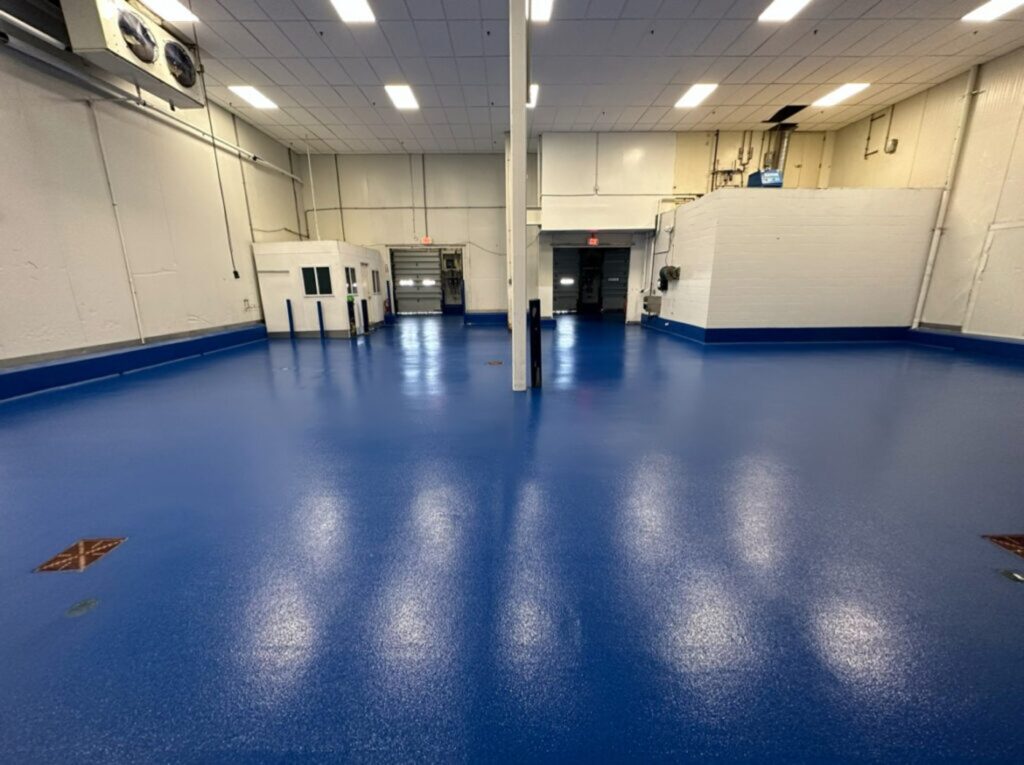
In this project they ground, repaired, and resurfaced 5,000 square feet of concrete at Stavis Seafood’s South Boston Waterfront facility. The crew installed Neogard urethane cementitious coating as the base system and finished it with a blue epoxy topcoat. Owner Ken Bonney of NEFLOORWALL led the installation.
Epoxy Flooring Project Facts
| Item | Detail |
|---|---|
| Client | Stavis Seafood (founded 1929) |
| Location | South Boston Waterfront, Boston, MA |
| Floor area | 5,000 SF of existing concrete |
| Scope | Diamond grinding, crack repair, urethane cement resurfacing, blue epoxy finish |
| Base system | Neogard urethane cementitious coating |
| Finish | Blue epoxy coating |
| Contractor | New England Floor and Wall, Ken Bonney, owner |
| Contact | (413) 642-5916 |
| Photos | New England Floor and Wall project gallery |
Why a seafood plant needs Epoxy Flooring and Coatings
Stavis Seafood processes more than 37 million pounds of seafood a year for customers worldwide. Its floor takes forklift and foot traffic all shift, then daily washdowns with hot water and cleaning chemicals.
Those conditions break down ordinary concrete and thin-film coatings. Four loads drove the product choice:
- Thermal shock: hot-water washdowns next to cold storage and ice cause rapid temperature swings.
- Moisture: standing water and constant wet cleaning.
- Chemicals: sanitizers, degreasers, and organic acids from seafood processing.
- Impact and abrasion: heavy equipment, pallets, and dropped product.
Urethane cement is built for this combination. It is a trowel- or slurry-applied system that cures into a dense, seamless surface rated for thermal cycling, wet service, and chemical exposure. That is why it is a common specification for food and beverage plants.
Urethane cement vs. epoxy flooring
| Property | Urethane cement | Epoxy alone |
|---|---|---|
| Thermal shock tolerance | Designed for hot washdown and freezer cycling | Can crack or delaminate under rapid temperature change |
| Moisture tolerance | Tolerates damp, high-moisture slabs | Needs a dry substrate |
| Typical role at Stavis | Structural base layer | Color and finish topcoat |
The Stavis system uses both: urethane cement for performance, a blue epoxy topcoat for appearance.
The epoxy floor and urethane cement installation process
- Surface preparation: the crew diamond-ground the 5,000 SF slab to remove worn material and open the concrete profile for bonding.
- Crack and defect repair: cracks and surface damage were filled so the new system would cure flat and seamless.
- Urethane cement resurfacing: Neogard urethane cementitious coating was applied as the base layer, sealing the slab against water and chemicals.
- Epoxy finish: a blue epoxy coating was applied over the urethane cement.
New England Floor and Wall is a Neogard installation contractor. Ken Bonney, the company’s owner, led the work on site.
Result
Stavis Seafood now operates on a seamless urethane cement floor across 5,000 SF of its South Boston processing space. The system replaced damaged concrete with a surface matched to the plant’s washdown, temperature, and traffic conditions.
Planning a food processing floor in Boston? Call New England Floor and Wall at 617-202-2973 to discuss urethane cement for your facility.
Epoxy Flooring and Urethane Cement: Frequently Asked Questions
What is the difference between epoxy flooring and urethane cement?
Epoxy flooring uses an epoxy resin system to create a seamless, durable surface. Urethane cement combines polyurethane resin with cement-based aggregate. Both serve industrial facilities, but urethane cement is often selected for environments with frequent hot-water washdowns, moisture, and temperature changes.
Why do food processing and seafood facilities use urethane cement flooring?
Seafood and food processing facilities need floors that handle wet conditions, cleaning chemicals, and temperature changes near refrigerated areas. Urethane cement is commonly specified for these demanding conditions. The appropriate flooring system depends on the facility’s operating temperatures, cleaning procedures, and concrete condition.
Can epoxy flooring or urethane cement be installed over damaged concrete?
Yes, provided the concrete is suitable and properly prepared. For the Stavis Seafood project, New England Floor and Wall diamond-ground the existing slab and repaired cracks before installing the urethane cement system. Preparation helps establish a sound surface for the new flooring.
Can an epoxy flooring topcoat be applied over urethane cement?
Yes, when the products are compatible and specified as a complete system. At Stavis Seafood, the urethane cement base received a blue epoxy topcoat. Topcoat selection should account for the facility’s heat exposure, chemicals, moisture, and traction requirements.
Who installed the epoxy flooring system at Stavis Seafood?
New England Floor and Wall, led by owner Ken Bonney, installed the urethane


